Wednesday, October 6, 2010

Interesting 411

Contrapositive’s are interesting in chapter 6. Contrapositive’s are claims that are equivalent to one another if each is true. “The contrapositive of If A, then B is If not B, then not A. A claim and its contrapositive are equivalent” (EPSTEIN 124).  I have been using this type of claim for a long time and I never knew. I never had a teacher with me 24/7, pointing out what types of sentences I was using. Everyone uses contrapositive but they do not know. Now you know. This book tells it all! An example of contrapositive is:
If I go to prom, then my friends will go to prom.
If my friends went to prom, then I went to prom.
Another example is that is easier to understand contrapositive is via contrapositive.
If you pass I behind the wheel test, then I will get my license.
If i just got my license in the mail, then I passed my behind the wheel test.


Tuesday, October 5, 2010

Chapter 7


Chapter 7 is all about counter-arguments. In this section, I have learned about raising objections. What that means is that it is a “standard way to show that an argument is bad” (EPSTEIN 147). So we are questioning one’s statement or question. The book gives an good example of a raising objection. An example of mines is

Me: Let us go to the mall because I need more sweaters!
BFF: You have a lot already.
Me: Yes, but i need more to keep me warm in the winter.
BFF: You need to save your money for your car. You have no money to spend and plus you already have a closet filled with sweaters.

Here I have constructed an example of a raising objection. BFF would always object my claim.
Another thing I learned in this chapter is, refuting an argument. Direct ways of refuting an argument is to “show that at least one of the premises is dubious, show that the argument isn’t valid or strong, and show that the conclusion is false” (EPSTEIN 149). If the sentence is unrepairable or has a false conclusion, then the sentence is refuting an argument. 

Monday, October 4, 2010

Chapter 6

I learned a lot about compound claims in chapter 6. “A compound claims is one composing of other claim but which has to be viewed as just one claim” (EPSTEIN 113).  So I have been using compound claims all my life, ever since I learned how to write. A compound word consists of one word that can link two claims to make a compound. The word “or” makes a sentence a compound sentence. An example of a compound claim is:  should I get the black dress, or the red dress? I also learned in this chapter about modus ponens. This is a type of reasoning that if A, then B +A=B. An example of this is, if Rocco barks, then Jayden will wake up. A= Rocco barks, B= Jayden will wake up. It is an easy concept to learn. The opposite of this type of reasoning is called modus tollens, If A, then B+ not B, so not A. 

Wednesday, September 29, 2010

Useful 411… “Inferring and Implying”

In chapter 4 of the Epstein book, Epstein talks about inferring and implying at the end of chapter 4. Imply and infer means “ when someone leaves a conclusion unsaid, he or she is implying the conclusion. When you decide that an unstated claim is the conclusion, you are inferring that claim” (Epstein 74).  In the book, they used examples such as, “ Don’t forget we’re going to leave early for the beach tomorrow” said the father. The daughter came home at 3 in the morning and she was too sleepy to drive. The father implied that she should come home early so she can have a good nights rest and she can be up to drive early in the morning. He says one thing, and never states the conclusion. My own example is, “look at that car with all the dents on the car, she must not know how to drive”. I inferred that she didn’t know how to drive because the driver was a woman and the car has dents. Just because the car has dents doesn’t mean she don’t know how to drive. It can be that someone hit her car while its parked. Infer basically means a “conclusion about the unknown made on the basis of the known” (Cooper 22). So I know that her car is dent, but I made a conclusion.  

Tuesday, September 28, 2010

Internet Advertisement


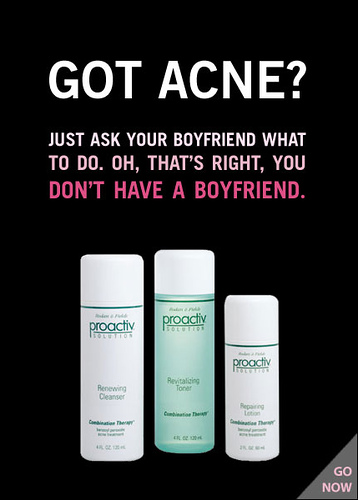
Chapter 5 talks about accepting and rejecting claims, also when to accept or reject claims. It is either by your personal experience or other useful sources, such as the media, journal or someone you trust that is really reliable. There is a lot of false advertisement on the Internet nowadays because technology is becoming better and everyone knows how to use ads. I found three types of advertisement on the web and I wouldn’t choose so I posted these three pictures up. These pictures are an ad of Proactiv Solution, which is some type of cream to help people get rid of acnes or pimples. I never tried this, but my friends have and they have told me that it works. Now their skins are a little clearer than before. But I also have friends that told me that it does not work. So in order for me to know if it works or not, I have to try it myself.  That is what I did. I had 1 zit on my face a week before prom and I wanted to get rid of it quick. My friends suggested proactiv and I tried it. It did not work. :( To accept a claim or reject a claim, our most reliable resources are ourselves. I can trust my friends, but half of my friends said it worked for them and the others said it does not. Proactiv solution is using celebrities to false advertise their company to get more customers. Just because celebrities use the products, doesn’t mean that you should use it so you can clear up the acne. This product works on different types of skin, and if your skin is the type that it doesn’t work on, then the ad was false because you didn’t get the skin like the Justin Bieber or Jessica Simpson. The last add is aiming it at girls to use this product in order for them to get a boyfriend. This is a false advertisement. We should reject this ad because we know the claim contradicts other claims that we know to be true.  

Monday, September 27, 2010

Repairing Arguments


A repair argument means “ given an (implicit) argument that is apparently defective, we are justified in adding a premise or a conclusion if it satisfies all three of the following: 1. The argument becomes stronger or valid. 2. The premise is plausible and would seem plausible o the other person. 3. The premises are more plausible than the conclusion (Epstein 62).

My example is: All math teachers are hard. So Mr. Moran is a hard teacher.

The premise is “all math teachers are hard”, and the conclusion is “ so Mr. Moran is a hard teacher”.

Looking at the examples on the book made me understand how to repair arguments or if a sentence needs a repair. So the example I made did not have a good argument. It has a conclusion, but there are not enough premises to back up the conclusion. The word “so”, indicates that there is a conclusion. All math teachers are hard but Mr. Moran can be an English teacher, psychical education teacher, or even a history teacher. He does not have to be a math teacher. This example that I made does not have enough examples, premises to it. Therefore, adding more premises will make the sentence makes it weak, so this example that I made up is not repairable.

Tuesday, September 14, 2010

Structure of Argument


I chose the first one on the structure of argument exercise. Yes I do believe that there is an argument in this short paragraph. The conclusion is “It is bad for the neighborhood, and it will decrease property value”. There is no need to add additional premise. In my opinion, I believe the subargument is in sentence one and two because it is the  “conclusion that turns around and acts as a premise in support of a further conclusion”. I don’t think this is a good argument, but it is ok to start off with. It needs to be revised and add more details. I thought that this exercise was very useful because it tells me what I am doing, and what I am explaining. This exercise gives me a clear understanding on what I am doing and what I am missing; such as, a conclusion. If I was missing a conclusion, I would need to put one in or else I am giving the premises for no reason and nothing will make since. Another example, if I were missing an argument, it also wouldn’t be right. This is like an organizational chart, meaning a chart that tells you what you need to improve on or what you are doing that is good. This is very useful and I think it’s a good structure of making a good argument.